

Alexander Graham Bell’s mother was deaf. He communicated with her using the British two-handed manual alphabet, and he knew American Sign Language.¹ His father, Alexander Melville Bell, developed a system called “Visible Speech,” a notation of symbols corresponding to mouth positions designed to teach deaf people to produce spoken sounds, and his father’s father worked in the same field.² Bell married Mabel Hubbard, a deaf woman who had been one of his students in oral education.³
Bell taught deaf children before inventing the telephone, which made him extraordinarily wealthy.⁴ He spent that wealth, by his own repeated account, on what he considered his more important work: the promotion of oralism, the pedagogical philosophy that deaf children should be taught exclusively through lip-reading and speech production, with sign language prohibited entirely.⁵

In 1883, Bell presented a paper to the National Academy of Sciences, published in 1884 under the title Memoir upon the Formation of a Deaf Variety of the Human Race.⁶ The paper compiled data on the hereditary aspects of deafness and observed that deaf people tended to socialize with one another, form clubs, attend the same residential schools, and marry other deaf people, and that the proportion of deaf children born to deaf parents exceeded the proportion born to the general population.⁷ From these observations Bell concluded that a “deaf race” was forming, and that it posed what he characterized as a threat to the species.
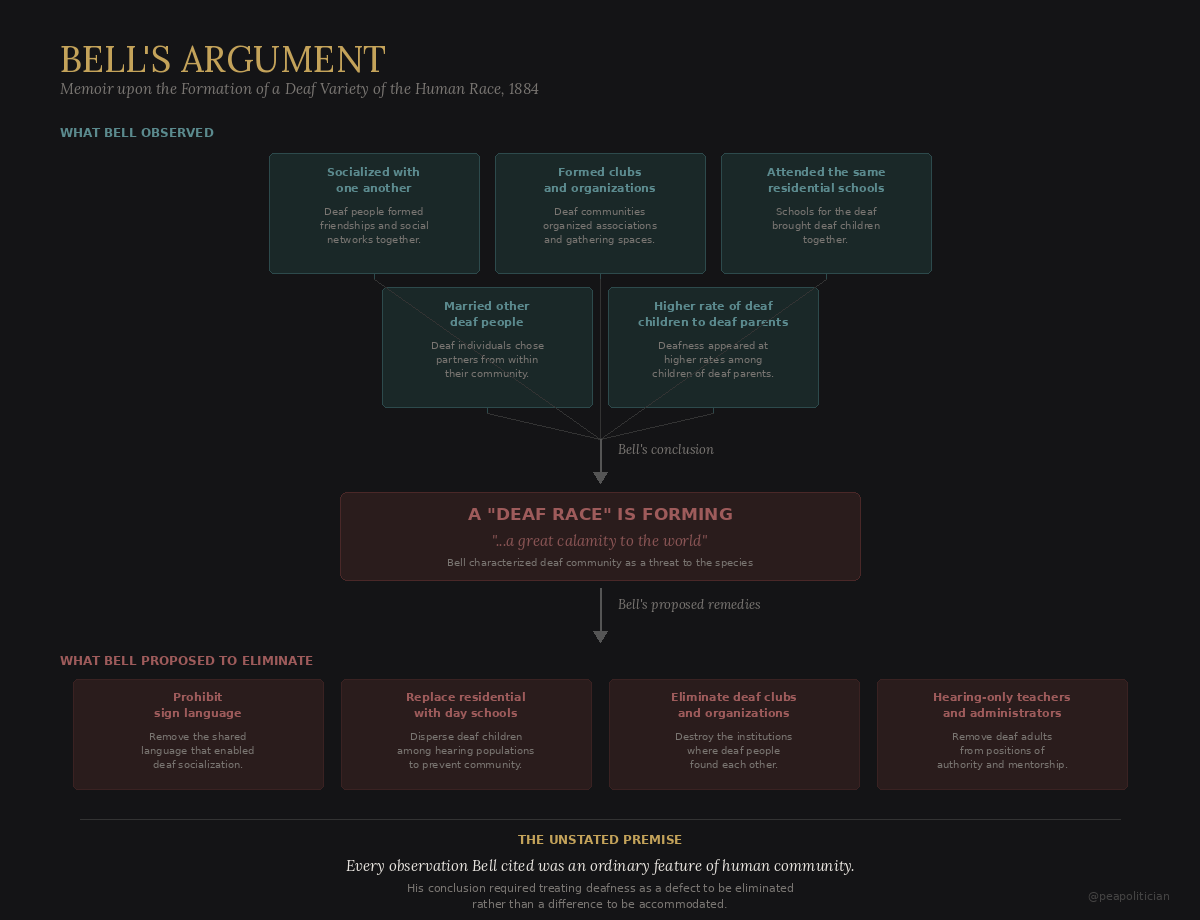
“Those who believe as I do,” he wrote, “that the production of a defective race of human beings would be a great calamity to the world, will examine carefully the causes that lead to the intermarriage of the deaf with the object of applying a remedy.”⁸
Bell did not call for the sterilization of deaf people, and he did not support sterilization legislation during his lifetime.⁹ The remedies he proposed were: prohibiting the use of American Sign Language in residential schools, eliminating deaf social clubs and organizations, ensuring that deaf children were taught exclusively by hearing teachers and administrators, and replacing residential schools with day schools that would keep deaf children dispersed among hearing populations.¹⁰ If deaf people cannot find each other, Bell reasoned, they cannot form community; if they cannot form community, they cannot marry each other; if they cannot marry each other, they cannot produce deaf children.
Bell printed the Memoir and sent it to members of Congress, to the principals of schools for the deaf, and to other figures involved in deaf education.¹¹ Other researchers challenged his empirical claims, noting that although deafness can be inherited, only a small percentage of deaf parents have deaf children.¹² Bell went on to found the Alexander Graham Bell Association for the Deaf, which trained teachers in oral methods,¹³ joined the American Breeders Association, served on their Committee on Eugenics, headed their Committee on Deaf Mutism, helped organize the First International Conference on Eugenics in 1912, served as honorary president of the Second International Congress of Eugenics in 1921, and served as chairman of the board of scientific directors of the Eugenics Record Office at Cold Spring Harbor from 1912 to 1918.¹⁴
The Second International Congress on Education of the Deaf convened in Milan from September 6 to 11, 1880, three years before Bell presented his Memoir.¹⁵ The conference was organized by a committee created by the Pereire Society.¹⁶ The organizers invited a majority of known oralists, took delegates on tours of local schools that had declared themselves oralist successes, and encouraged hostile reactions to speakers who supported sign language.¹⁷ Of the delegates, over half were Italian and just over a quarter were French, and there were as few as one to four deaf participants depending on the source.¹⁸
At the close of the congress, the delegates passed eight resolutions. The first declared “the incontestable superiority of articulation over signs” and that “the oral method should be preferred to that of signs in the education and instruction of deaf-mutes.” The second declared that “the simultaneous use of articulation and signs has the disadvantage of injuring articulation and lip-reading and the precision of ideas” and that “the pure oral method should be preferred.”¹⁹ The American and British delegations opposed the resolutions but were outvoted.²⁰
After the Milan resolutions passed, schools across Europe and the United States converted to oral-only instruction, and sign language was removed from classrooms.²¹ Deaf teachers, who had constituted approximately 40 percent of the profession in the 1860s, were dismissed and replaced by hearing teachers trained in oral methods, and by 1920 that figure had fallen below 15 percent.²² By the mid-twentieth century, eighty percent of American secondary schools for the deaf used the oral method exclusively.²³
In some schools, children had to wear mittens or sit on their hands as punishment for signing, while in others their hands were slapped with rulers or tied together, and teachers physically restrained students’ hands and covered their mouths throughout the school day.²⁴ Some schools extended the prohibition beyond their own grounds: students observed signing in secret off campus, if a witness reported it, were punished upon their return.²⁵ Hours each day that had previously been devoted to academic subjects were instead spent teaching deaf children to produce spoken English through lip-reading and the imitation of mouth shapes and breathing patterns, a method that was acquired fluently by only a small number of students, many of whom did not achieve it until well past the critical age for language acquisition.²⁶
Prior to 1880, deaf communities in the United States and Europe had produced writers, artists, lawyers, politicians, and educators, all of whom communicated in sign language.²⁷ After the Milan resolutions took effect, the number of deaf professionals declined.²⁸
Despite the prohibitions and the punishments, the children continued to sign. They signed in dormitories after lights out, off campus where no teacher could observe them, and in whatever spaces they could find beyond the reach of enforcement, teaching the language to one another without adult instruction or institutional support.²⁹
In 1965, the United States Congress released the Babbidge Report, which concluded that oralism was a “dismal failure” and that oral-only education was inadequate for deaf children.³⁰ The report was advisory.
In 1980, at the 15th International Congress on the Education of the Deaf in Hamburg, a large group of attendees informally rejected the 1880 resolutions, but rather than overturn them directly the Congress issued “recommendations” for informational purposes, affirming that “all deaf children have the right to flexible communication in the mode or combination of modes which best meets their individual needs.”³¹
In 2010, at the 21st ICED in Vancouver, the board issued a formal apology, acknowledging the ban as an act of discrimination and a violation of human and constitutional rights.³² The 1880 resolutions remained on the institutional record.
On July 11, 2025, at the 24th ICED in Rome, the World Federation of the Deaf, the European Union of the Deaf, and the Italian National Association of the Deaf jointly issued a declaration that “fully and unequivocally” renounced the Milan resolutions.³³ The declaration deplored “the profound and long-lasting harm caused by those resolutions, including the widespread exclusion of sign languages from educational systems and the systematic language deprivation experienced by generations of deaf children,” and affirmed that sign languages are “full and natural human languages.”³⁴ The organizers described holding the conference in Italy as “an opportunity for social redemption.”³⁵
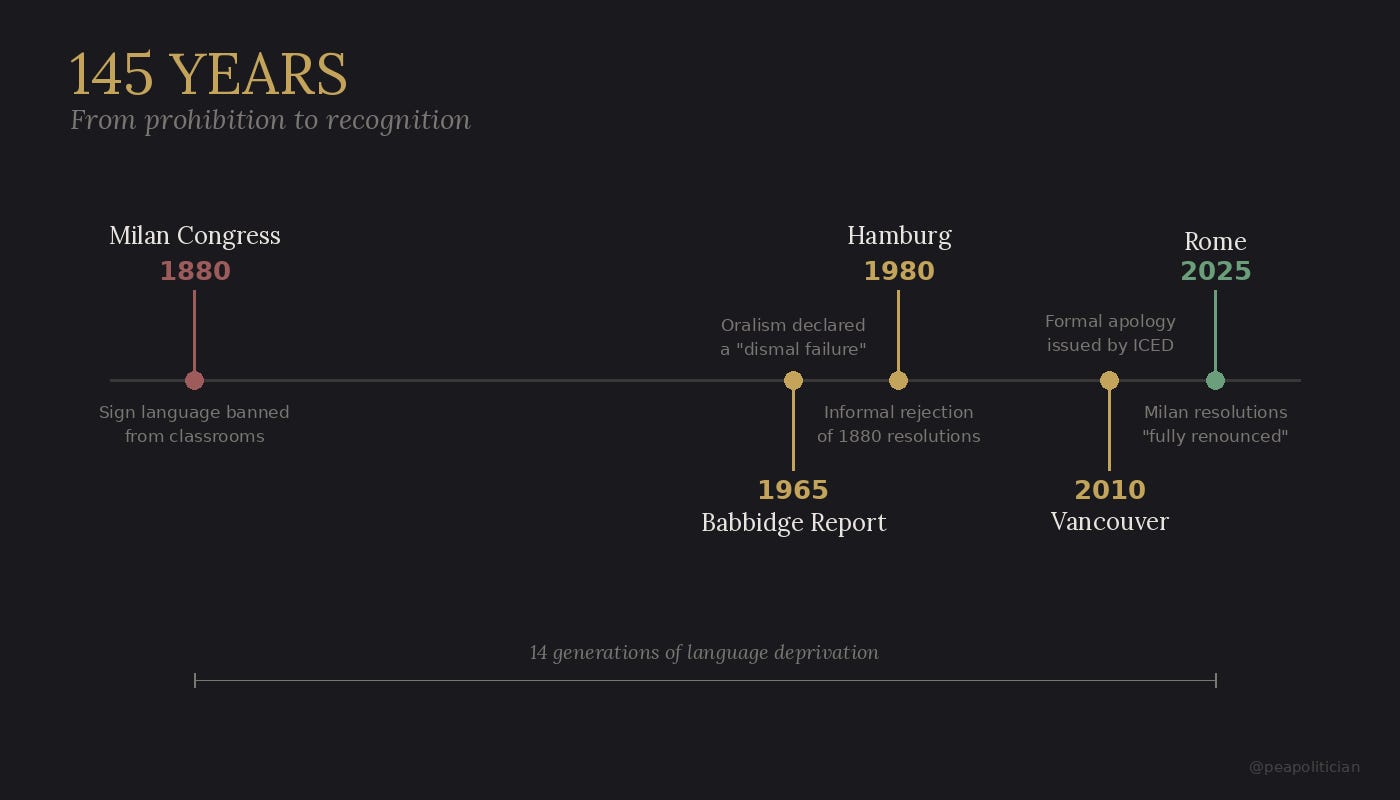
The World Federation of the Deaf president, addressing the assembly, stated that 14 generations of deaf children had experienced language deprivation, physical abuse including having their hands tied down and slapped, and psychological abuse through shame for using what the declaration now recognized as a natural human language.³⁶ He noted that some people in the room still adhered to the principles of oralism, and told them: “Let go.”³⁷
Alexander Graham Bell died on August 2, 1922.³⁸ The Milan resolutions remained in effect for another 103 years.
Endnotes
Bell’s knowledge of ASL and his use of the British manual alphabet with his mother are documented in the Gallaudet University Museum exhibit “History Through Deaf Eyes.”
Alexander Melville Bell’s “Visible Speech” system is described in “Alexander Graham Bell and His Role in Oral Education,” Disability History Museum, disabilitymuseum.org/dhm/edu/essay.html?id=59, and in Katie Booth, The Invention of Miracles: Language, Power, and Alexander Graham Bell’s Quest to End Deafness (New York: Simon & Schuster, 2021).
Mabel Hubbard was one of Bell’s students in oral education. See the Disability History Museum essay cited in note 2; Booth, The Invention of Miracles.
Bell taught deaf children in Boston before and after inventing the telephone. See the Disability History Museum essay cited in note 2.
The Disability History Museum records that Bell “used his fame and wealth from the telephone to advocate these beliefs. His name became synonymous with oralism.” See the essay cited in note 2.
Alexander Graham Bell, “Memoir upon the Formation of a Deaf Variety of the Human Race,” presented to the National Academy of Sciences at New Haven, November 13, 1883; published in Memoirs of the National Academy of Sciences, Vol. 2, pp. 177-262 (Washington, D.C.: National Academy of Sciences, 1884). A digital copy is held at the Gallaudet University Library Deaf Collections and Archives and is available through the Internet Archive at archive.org/details/gu_memoirformati00bell.
Bell, “Memoir upon the Formation of a Deaf Variety of the Human Race,” pp. 177-262.
Id. The quoted passage appears in the Memoir’s introductory discussion of the hereditary implications of deaf intermarriage.
The Bell Legacy Foundation and multiple secondary sources confirm that Bell did not advocate for sterilization of deaf people. See “Was Bell an Advocate for Genetic Research on Humans?,” Alexander & Mabel Bell Legacy Foundation, belllegacy.org (2021). The Eugenics Archive at eugenicsarchive.ca records that Bell “did not support sexual sterilization legislation,” citing Ruth Clifford Engs, The Eugenics Movement: An Encyclopedia (Westport, CT: Greenwood Press, 2003).
Bell, “Memoir upon the Formation of a Deaf Variety of the Human Race.” Bell’s specific proposals are discussed in the Memoir and analyzed in Booth, The Invention of Miracles; Brian H. Greenwald, “The Real ‘Toll’ of A. G. Bell: Lessons About Eugenics,” in Genetics, Disability, and Deafness, ed. John Vickrey Van Cleve (Washington, D.C.: Gallaudet University Press, 2004).
Bell, “Memoir upon the Formation of a Deaf Variety of the Human Race.” The Memoir was printed separately and distributed to members of Congress, principals of schools for the deaf, and other figures in deaf education. See Booth, The Invention of Miracles.
The empirical limitations of Bell’s claims regarding hereditary deafness were noted by contemporary researchers and are discussed in Greenwald, “The Real ‘Toll’ of A. G. Bell.”
Bell founded the American Association for the Promotion of the Teaching of Speech to the Deaf in 1890, later renamed the Alexander Graham Bell Association for the Deaf and Hard of Hearing. See the Disability History Museum essay cited in note 2.
Bell’s involvement in the eugenics movement is documented in multiple sources. He served on the Committee on Eugenics of the American Breeders Association and headed their Committee on Deaf Mutism. See Engs, The Eugenics Movement: An Encyclopedia (2003). Bell served as chairman of the board of scientific directors of the Eugenics Record Office at Cold Spring Harbor from August 23, 1912 to January 1, 1918, when the office was transferred to the Carnegie Institution of Washington. See “Alexander Graham Bell as Chairman of the Board of Scientific Directors of the Eugenics Record Office,” Eugenical News, Vol. 14, No. 8, held at the Cold Spring Harbor Laboratory DNA Learning Center. Bell helped organize the First International Conference on Eugenics in 1912 and served as honorary president of the Second International Congress of Eugenics, held under the auspices of the American Museum of Natural History in 1921. See Engs; the Eugenics Archive at eugenicsarchive.ca.
Report of the Proceedings of the International Congress on the Education of the Deaf, Held at Milan, September 6th-11th, 1880. The original proceedings were published in English, French, and Italian shortly after the conference and are held at Gallaudet University. The Milan Congress proceedings have been submitted by the World Federation of the Deaf, in collaboration with The Nippon Foundation, for inclusion in the UNESCO Memory of the World Register. See UNESCO, “Key Documents for Deaf Communities: the Milan Congress, 1880,” unesco.org/en/memory-world/key-documents-deaf-communities-milan-congress-1880.
The Pereire Society, established in honor of Jacob Rodrigues Pereire, the first oral teacher of the deaf in France, organized both the First International Congress on Education of the Deaf (Paris, 1878) and the Milan conference. See Gallaudet University Archives, MSS-079; Deaf History Europe, “Milan 1880: Who?,” deafhistory.eu.
The Wikipedia article on the Second International Congress on Education of the Deaf, citing multiple sources, records that the organizers “secured this outcome by carefully selecting who was invited to the Milan Conference, inviting the delegates to see the self-declared oralist success in local schools, and by encouraging negative reactions to those giving speeches supporting sign language and cheering those supporting oralism.”
Sources differ on the number of participants and deaf attendees. The Gallaudet University archives and the European Deaf History website record 164 delegates; other sources cite 256 attendees, a figure that may include non-voting observers and guests. The European Deaf History website identifies one deaf delegate, James Denison of the United States. Wikipedia names four deaf attendees: Claudius Forestier, Joseph Theobald (a teacher at the Institut National de Jeunes Sourds de Paris), James Denison (director of the Kendall School), and Lorenzo del Lupo (an Italian student).
The resolutions are quoted from the published proceedings of the Milan Conference. See note 15.
Edward Miner Gallaudet led the American delegation’s opposition to the resolutions. See Gallaudet University Archives, MSS-079; the proceedings cited in note 15.
Deaf History Europe, “1880: the Milan Conference,” deafhistory.eu: “After its passage in 1880, schools in European countries and the United States switched to using speech therapy without sign language as a method of education for the deaf.”
Gallaudet University Museum, “History Through Deaf Eyes,” exhibit panel “Oral Training in ‘Signing Schools’”: “In signing schools, the total number of deaf teachers was reduced from 40 percent of the profession in the 1860s to less than 15 percent by 1920, though the numbers varied widely from school to school.” See gallaudet.edu/museum/exhibits/history-through-deaf-eyes/language-and-identity/oral-training-in-signing-schools/.
Wikipedia, “Oralism,” citing secondary sources: “by the mid-20th century, eighty percent of American secondary schools for the deaf used the oral method exclusively.” This figure is consistent with the broader historical literature on oralism’s dominance, including Booth, The Invention of Miracles.
Gallaudet University Museum, “History Through Deaf Eyes,” exhibit panel “Oral Training in ‘Signing Schools’”: “In some schools, students had to wear mittens or sit on their hands as a punishment for signing. Other schools used more severe reprimands.” See also the Wikipedia article on the History of Deaf Education in the United States: “Students caught using sign language in oral programs were often punished.”
The enforcement of signing prohibitions off campus is documented in multiple secondary sources on oralist-era discipline. See Booth, The Invention of Miracles; Paddy Ladd, Understanding Deaf Culture: In Search of Deafhood (Clevedon, UK: Multilingual Matters, 2003).
The developmental consequences of delayed language acquisition in deaf children educated under oral-only regimes are well documented in the linguistic and developmental psychology literature. See, e.g., Rachel I. Mayberry, “When Timing Is Everything: Age of First-Language Acquisition Effects on Second-Language Learning,” Applied Psycholinguistics, Vol. 28, No. 3 (2007), pp. 537-549.
Deaf History Europe, “1880: the Milan Conference,” deafhistory.eu; Gallaudet University Museum, “History Through Deaf Eyes.”
Deaf History Europe, “1880: the Milan Conference,” deafhistory.eu: “As a result, deaf teachers lost their jobs, as there was an overall decline in deaf professionals, like writers, artists, and lawyers.”
The persistence of signing among students despite prohibitions is documented in multiple sources. See Gallaudet University Museum, “History Through Deaf Eyes”; Booth, The Invention of Miracles; Harlan Lane, When the Mind Hears: A History of the Deaf (New York: Random House, 1984).
Homer D. Babbidge Jr. et al., Education of the Deaf: A Report to the Secretary of Health, Education, and Welfare by His Advisory Committee on the Education of the Deaf (Washington, D.C.: U.S. Government Printing Office, 1965). ERIC document ED014188. The National Association of the Deaf has characterized the report as concluding that “oral education of the deaf” was “a dismal failure.” See “NAD Responds to The New York Times Debate on Deaf Education,” nad.org, August 31, 2011.
The 15th ICED, Hamburg, 1980. Richard G. Brill described the informal rejection of the Milan resolutions: “At the International Congress in Hamburg in 1980, the Milan resolutions were challenged head-on in major professional addresses at the opening of the congresses.” The Congress issued recommendations rather than formal reversals. See the Wikipedia article on the Second International Congress on Education of the Deaf, citing Brill.
The 21st ICED, Vancouver, 2010. The board voted to reject the 1880 resolutions and issued a formal apology. See the Wikipedia article on the Second International Congress on Education of the Deaf; UNESCO, “Key Documents for Deaf Communities: the Milan Congress, 1880.”
World Federation of the Deaf, European Union of the Deaf, and Italian National Association of the Deaf, Joint Declaration at the 24th International Congress on the Education of the Deaf, Rome, Italy, July 11, 2025.
Id.
Id. The organizers’ description of the Rome venue as “an opportunity for social redemption” is recorded in coverage of the 24th ICED.
The WFD president’s remarks at the opening of the 24th ICED are documented in coverage of the congress, including his reference to 14 generations of language deprivation and physical and psychological abuse.
Id.
Alexander Graham Bell died on August 2, 1922, at his estate in Baddeck, Nova Scotia. See Booth, The Invention of Miracles.