

The common-law rule
For most of the history of the law that the American states inherited from England, a dispute between a mother and a father over the custody of their child had a settled answer, and the answer was the father. The rule was stated most influentially by William Blackstone, an English jurist whose account of the law of England, published in the volume of his Commentaries that appeared in 1765, was the work through which the common law was received and taught in the United States. Describing the authority of a father over his children, Blackstone paused to observe, in a parenthesis, that a mother as such was entitled to no power, but only to reverence and respect.1
That allocation did not stand alone. It followed from the legal structure of marriage itself. Under the doctrine of coverture, which Blackstone set out in the same work, a married woman’s legal personality merged into her husband’s for the duration of the marriage, so that while married she could not own property in her own name, keep her own earnings, or sue and be sued on her own account.2
A wife who had no separate legal existence in the law of property and contract had no separate claim to the children of the marriage either. Custody belonged to the husband as the head of the household, and the courts enforced that entitlement through the writ of habeas corpus, the order by which a court tests whether a person is lawfully held by another.
New York receives the rule
When the American colonies became independent states, each kept the English common law in force as its own law, and New York received the common-law rule of the father’s right in that way. A single protracted custody dispute from the same period shows both the force of the rule and the first exception to it. Beginning in 1838, John A. Barry, who had separated from his wife, sought the custody of the couple’s infant daughter through a succession of habeas corpus proceedings in the New York courts. In the course of that litigation the New York Supreme Court, in an opinion by Justice Greene Bronson, restated the common-law rule, describing the husband, if he chose to assert his right, as having the better title to the custody of the minor children, and describing the law as regarding him as the head of the family and committing the children to his charge in preference to the mother.3
The state’s highest court at the time, the Court for the Correction of Errors, nonetheless declined to order the daughter taken from her mother. Its reported rule was that although a father is in general entitled to the custody of his children, a child of tender age and delicate health who has been left with her mother will not be transferred to the father by habeas corpus, and will especially not be transferred where the father’s fitness for the task is not equal to the mother’s.4 Barry carried the matter into the federal courts, and in 1847 the Supreme Court of the United States dismissed his writ of error, holding that a contest between two parents over the custody of a child concerned no matter capable of a monetary value and so lay outside the Court’s power to review.5
The rule that the custody of a child is a matter for the courts of the state and not for the federal courts has held ever since, and the principle behind it, that the domestic relations of parent and child belong to the law of the states, was restated by the Supreme Court as recently as 1992.6 The daughter remained with her mother.
What the litigation records is a rule still intact and an exception beginning to form inside it. The father’s right remained the stated law. Alongside it, and in the same proceedings, the courts had started to recognize a qualification for children of tender age, a qualification expressed in terms of the young child’s need for the mother and the mother’s greater suitability to meet it.
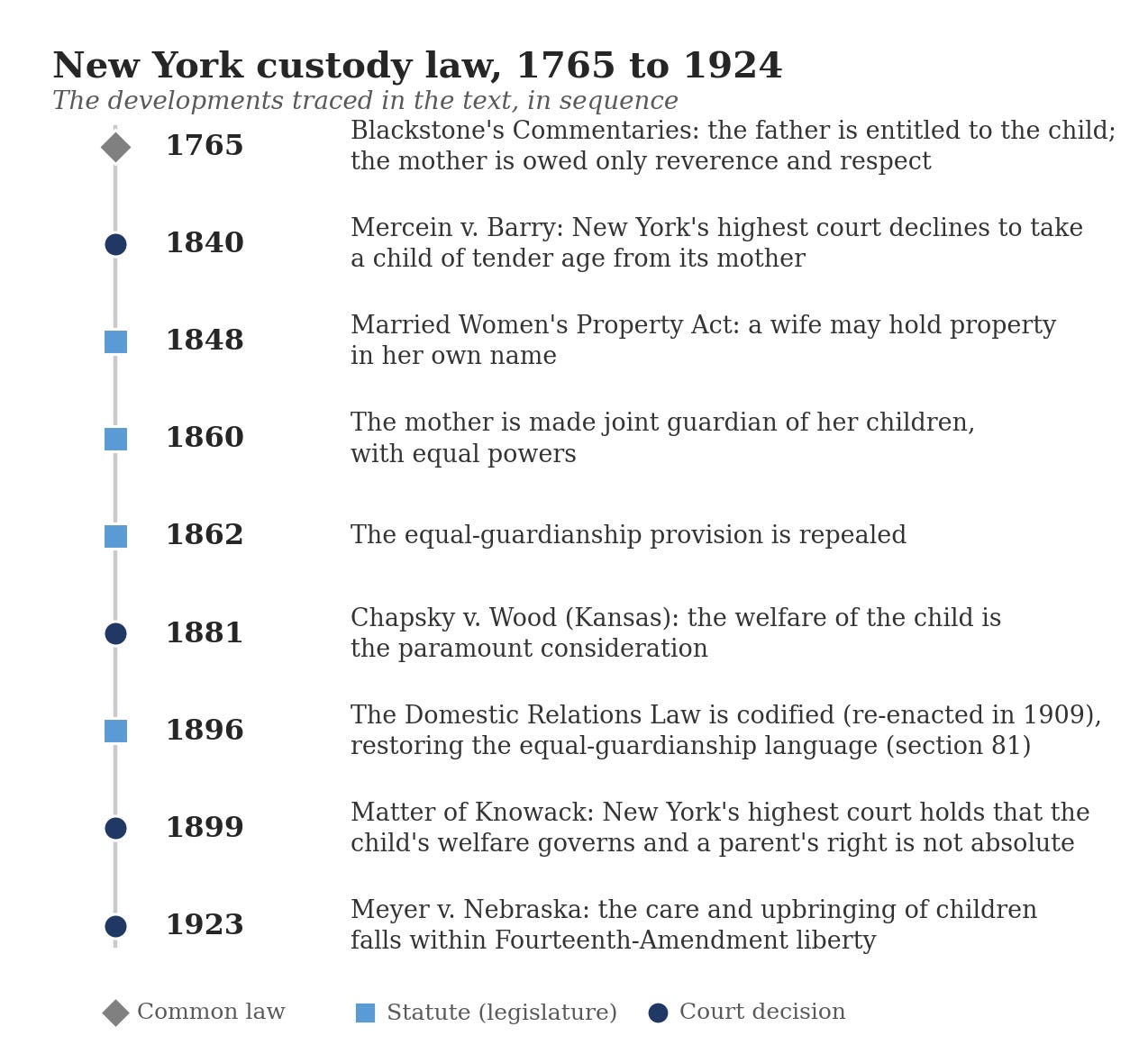
Figure 1. The developments traced in what follows, in sequence, distinguishing acts of the legislature from decisions of the courts.
The legislature grants, withdraws, and restores
While the courts were shaping that qualification, the New York legislature was altering the legal position of married women directly, though not along a straight line, which makes it harder to follow, and the timeline above is meant to assist in following. In 1848 it passed an act for the protection of the property of married women, the first statute of its kind in the country, which allowed a married woman to hold real and personal property in her own name, free of her husband’s control.7
That act addressed property and said nothing of custody or guardianship. In 1860 the legislature went further, passing an act concerning the rights and liabilities of husband and wife that secured to a married woman the control of her own earnings and made her the joint guardian of her children, together with her husband, with equal powers over them.8 For the first time a New York statute placed the mother on an equal legal footing with the father as to the children of the marriage.
That equality lasted only two years. In 1862 the legislature amended the 1860 act and removed the equal-guardianship provision, leaving the mother with no more than a limited power to object to the father’s apprenticing of a child or his appointment of a guardian by will.9 The withdrawal did not hold, and the provision that had made the mother and the father joint guardians with equal powers was restored to the statute books by later legislation and stands today as the opening sentence of the article on guardians in the Domestic Relations Law, which provides that a married woman is a joint guardian of her children with her husband, with equal powers, rights and duties in regard to them.10
That law, first codified as a single Domestic Relations Law in 1896 and re-enacted as chapter fourteen of the Consolidated Laws in 1909, is the statute in force today, so that what the legislature granted in 1860 and took back in 1862 stands, in the same words, as current New York law.
The end of the father’s right
The dismantling of coverture took away the ground on which the father’s right had stood.
Coverture was a historical legal doctrine under English common law where a woman’s legal rights and identity were subsumed by those of her husband upon marriage.
The common law had given the father the child as an incident of his position as the head of a household in which his wife had no separate legal existence, and once the legislature allowed a married woman to hold her own property, keep her own earnings, and share in the guardianship of her children, the reason the law had once given for preferring the father was gone. The statutes that dismantled coverture did not themselves transfer the child to the mother; as the last section shows, they placed the two parents on an equal footing and directed no preference between them. What replaced the father’s right came instead from the courts, and it was not a right vested in either parent but a standard that subordinated the claims of both to the welfare of the child.
The principle that the disposition of a child turns on the child’s welfare rather than on the right of either parent had been stated by American courts across the nineteenth century, and the decision most often cited as its clearest early expression was handed down in 1881 by Justice David Brewer of the Supreme Court of Kansas, who would afterward sit on the Supreme Court of the United States, holding that above all things the paramount consideration in a contest over a child is what will promote the welfare of the child.11
That principle entered the law of New York in the same period. The New York Court of Appeals, the state’s highest court, stated it in 1899, in a case concerning children who had been taken from parents found unfit and then returned to them once the parents reformed, holding that the welfare of the child governs and that the right of a parent to the custody of a child is not absolute.12 By the close of the nineteenth century the rule that had once given the father the whole of the right had been replaced, in its stated form, by a standard that named neither parent and asked only what the welfare of the child required.
The tender-years presumption
That standard, which named neither parent, did not operate without a thumb on the scale. Within the inquiry into the child’s welfare the courts developed a presumption that the welfare of a young child, where the two parents were otherwise equally fit, lay with its mother, and this presumption came to be known as the tender-years doctrine. It had a parallel and earlier development in England, where Parliament, responding to a campaign led by the writer Caroline Norton, whose own separation had deprived her of her children, passed the Custody of Infants Act of 1839 to allow a court to place a child under the age of seven with its mother, and extended that power in 1873 to children under the age of sixteen.13
In the United States the presumption took hold through judicial decision rather than by statute, and its earliest New York expression was the qualification already described, the refusal of the state’s highest court in the 1840s to take a child of tender age from its mother. The presumption did not restore to the mother a right of the kind the father had once held, and it did not reverse his legal standing, which remained equal to hers; it operated as a rule of thumb about where a young child’s welfare lay when nothing else separated the parents, applied within the inquiry into that welfare rather than in place of it.14 A mother’s claim to a young child, all else being equal, now carried a weight that the common law of a century before had reserved to the father, but it carried that weight as a presumption about the child’s welfare and not as a right of her own.
The law by the early 1920s
By the early 1920s the law of custody in New York, taken at the level of its statutes and its highest court, named neither parent. The statute had returned the mother to an equal footing with the father in the guardianship of their children, and the Court of Appeals had framed the custody question as a matter of the welfare of the child rather than the right of either parent. In the same period the Supreme Court of the United States placed the care and upbringing of children within the liberty that the Fourteenth Amendment protects against the state, holding in 1923, in striking down a state law that forbade the teaching of foreign languages to young children, that the authority of parents to direct the upbringing and education of their children fell within that liberty.15 At the level of the stated law, the care of children had become a matter of the child’s welfare and of a liberty held by both parents alike.
Yet the formal neutrality of that stated law did not fully determine how custody questions were resolved in practice.
Beneath that stated law, the presumption that a young child belonged with its mother had begun to operate in the practice of the courts. The movement of custody away from the father, who at the start of the period had held the whole of the right, had therefore been carried neither by the statutes of New York, which named neither parent, nor by the stated doctrine of its highest court, which asked only what the welfare of the child required, but by a presumption the courts had fashioned within that doctrine and applied beneath it.
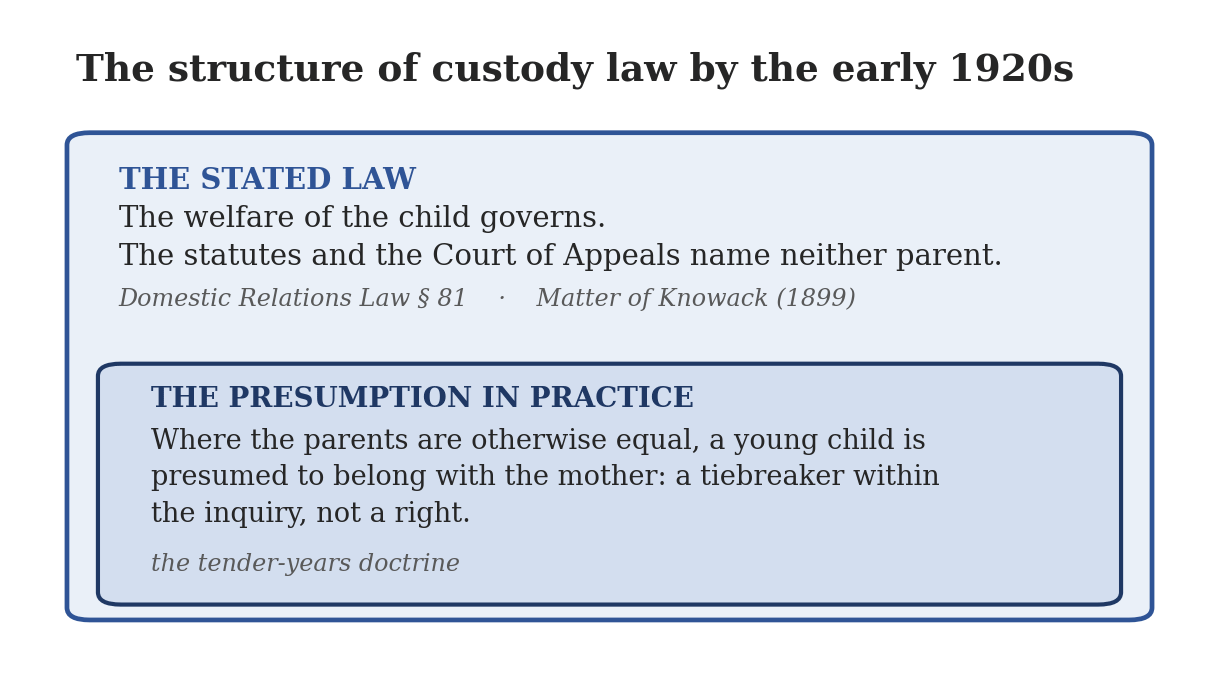
Figure 2. The structure of the law by the early 1920s: a formally neutral standard that named neither parent, with a tender-years presumption favoring the mother for young children operating beneath it in the practice of the courts.
How far that presumption would harden, whether it would be tested against the neutral standard the law professed, and what would become of the further idea that both parents should share the child after a separation, are the subjects of the parts that follow.
End Notes
1. William Blackstone, Commentaries on the Laws of England, Book I, ch. 16 (Of Parent and Child) (1765) (“a mother, as such, is entitled to no power, but only to reverence and respect”). https://avalon.law.yale.edu/18th_century/blackstone_bk1ch16.asp
2. William Blackstone, Commentaries on the Laws of England, Book I, ch. 15 (Of Husband and Wife) (1765) (coverture; the legal unity of husband and wife). https://avalon.law.yale.edu/18th_century/blackstone_bk1ch15.asp
3. People ex rel. Barry v. Mercein, 3 Hill 399 (N.Y. Sup. Ct. 1842) (Bronson, J.) (restating the paternal right); the opinion is reproduced with the related proceedings in the Barry and Mercein litigation at CourtListener. https://www.courtlistener.com/opinion/5668607/mercein-v-people-ex-rel-barry/
4. Mercein v. People ex rel. Barry, 25 Wend. 64 (N.Y. Court for the Correction of Errors 1840) (declining to transfer a child of tender age and delicate health from the mother by habeas corpus). https://www.courtlistener.com/opinion/5668607/mercein-v-people-ex-rel-barry/
5. Barry v. Mercein, 46 U.S. (5 How.) 103 (1847) (Taney, C.J.) (dismissing the father’s writ of error for want of jurisdiction). https://www.law.cornell.edu/supremecourt/text/46/103
6. Ankenbrandt v. Richards, 504 U.S. 689 (1992) (reaffirming the domestic-relations exception, under which divorce, alimony, and child-custody decrees lie outside the diversity jurisdiction of the federal courts, and quoting In re Burrus, 136 U.S. 586, 593-594 (1890): “The whole subject of the domestic relations of husband and wife, parent and child, belongs to the laws of the States and not to the laws of the United States.”). https://supreme.justia.com/cases/federal/us/504/689/
7. An Act for the Effectual Protection of the Property of Married Women, L. 1848, ch. 200 (N.Y.), digitized by the New York State Archives. https://digitalcollections.archives.nysed.gov/index.php/Detail/objects/10821
8. An Act Concerning the Rights and Liabilities of Husband and Wife, L. 1860, ch. 90 (N.Y.) (securing a married woman’s earnings and making her a joint guardian of her children with her husband, with equal powers), as cited in the scholarly literature. https://www.aeaweb.org/conference/2017/preliminary/paper/DaaYNTSN
9. The 1860 act was amended in 1862 to remove the mother’s equal guardianship, leaving only a limited power to object to apprenticeship and to the appointment of a testamentary guardian. The precise 1862 chapter has not been pinned to the session laws and should be confirmed before publication. https://en.wikipedia.org/wiki/Timeline_of_women%27s_legal_rights_in_the_United_States_(other_than_voting)
10. N.Y. Dom. Rel. Law § 81 (opening sentence: “A married woman is a joint guardian of her children with her husband, with equal powers, rights and duties in regard to them.”). The Domestic Relations Law was first enacted as L. 1896, ch. 272, and re-enacted as L. 1909, ch. 19 (chapter 14 of the Consolidated Laws). The equalizing language granted in 1860 and removed in 1862 was restored by later legislation and survives as the opening sentence of § 81; the exact restoring chapter has not been pinned to the session laws and should be confirmed before publication. https://www.nysenate.gov/legislation/laws/DOM/81
11. Chapsky v. Wood, 26 Kan. 650, 40 Am. Rep. 321 (1881) (Brewer, J.) (the paramount consideration is the welfare of the child); the holding is quoted in Coles v. Coles, 204 A.2d 330 (D.C. 1964). Chapsky is the decision most often cited for the standard, not the first; American courts had reached for the child’s welfare earlier, as in Commonwealth v. Addicks, 5 Binn. 520 (Pa. 1813). https://law.justia.com/cases/district-of-columbia/court-of-appeals/1964/3562-3.html
12. Matter of Knowack, 158 N.Y. 482, 488 (1899) (welfare of the child governs; the right of a parent to custody is not absolute); the holding is quoted in a 2025 opinion of the New York Court of Appeals. https://www.nycourts.gov/ctapps/Decisions/2025/May25/43opn25-Decision.pdf
13. Custody of Infants Act 1839 (2 & 3 Vict. c. 54) (Talfourd’s Act) (custody of children under seven with the mother); Custody of Infants Act 1873 (36 & 37 Vict. c. 12) (extending the age to sixteen); the campaign of Caroline Norton. https://en.wikipedia.org/wiki/Tender_years_doctrine
14. On the character of the tender-years presumption as a tiebreaker that operated only where the parents were otherwise equal, and not as a reversal of the father’s legal right, see Ramsay Laing Klaff, The Tender Years Doctrine: A Defense, 70 Cal. L. Rev. 335 (1982). https://scholarship.law.berkeley.edu/californialawreview/vol70/iss2/2
15. Meyer v. Nebraska, 262 U.S. 390 (1923) (the liberty protected by the Fourteenth Amendment includes the right of parents to direct the upbringing and education of their children). https://www.law.cornell.edu/supremecourt/text/262/390