
What New Hempstead's Zoning Was Supposed to Protect from Development
Two recorded agreements promised to preserve 124 acres of the golf course as open space in perpetuity. The Village is now advancing a 325-home rezoning on the same land.

What New Hempstead Agreed to Protect
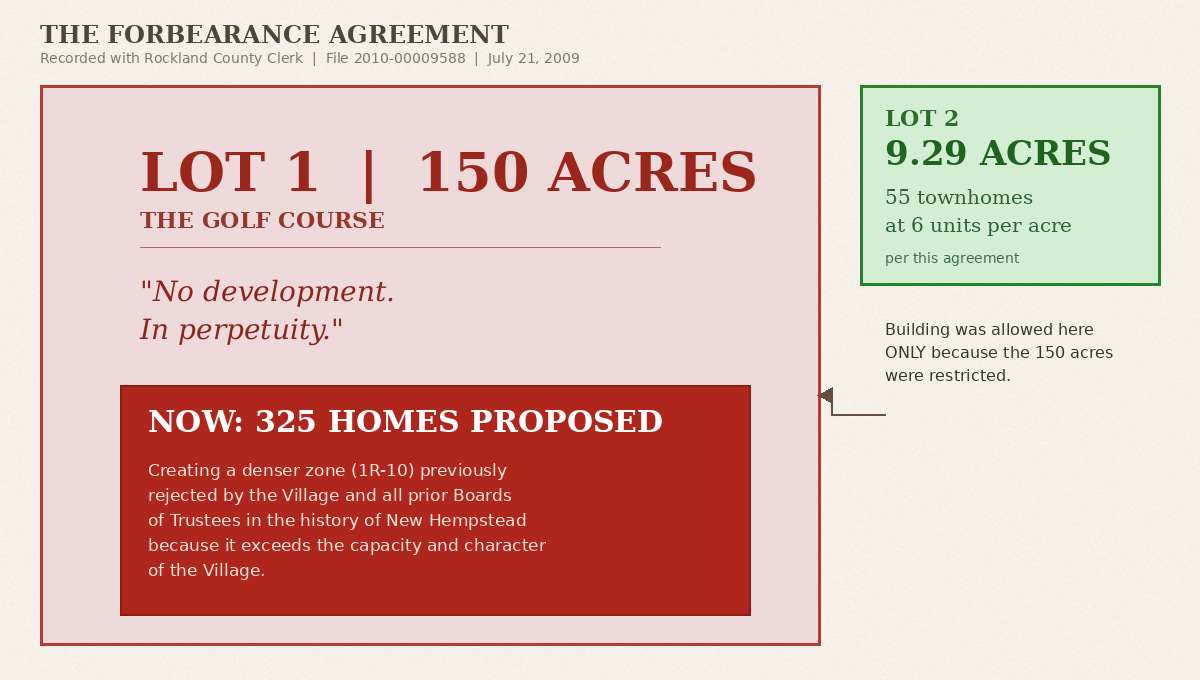
On March 12, 2024, Village Attorney Bruce Minsky told the New Hempstead Planning Board that under the terms of a recorded Forbearance Agreement, the 9.29-acre Union Road parcel was “the only part that was able to be developed” on the former New York Country Club property.[6] The remaining 150 acres of the golf course, he explained, were restricted by the same agreement.
The Village Board is now advancing a proposed rezoning of that same 150 acres for up to 325 single-family homes, in a zoning classification that does not exist in the Village Code.[1]
The agreements that created those restrictions are recorded with the Rockland County Clerk. So are the applications that contradict them.
The Forbearance Agreements
On January 8, 2007, New York Golf Enterprises Inc. and the Village of New Hempstead executed an Amended Forbearance Agreement, recorded with the Rockland County Clerk on September 6, 2007, as Instrument 2007-00044358.[2] The agreement acknowledged that the Village had enacted a moratorium on large lot subdivisions to study and implement a Comprehensive Plan, and stated that “the Village has an interest in maintaining the quality of life of its constituents and maintaining and preserving open space and undeveloped land within the Village.”
Under the 2007 agreement, New York Golf could apply to subdivide up to 28 acres for age-restricted housing at a density of no more than six units per acre. In exchange, upon final subdivision approval, New York Golf would file a restrictive covenant on the remaining 145± acres providing that “there shall be no development in perpetuity,” and would transfer the development rights on those acres to the Village as a recordable instrument. New York Golf also agreed to “forbear from and agree not to submit any other applications for subdivision other than outlined herein.”
On July 21, 2009, the parties executed a second Forbearance Agreement, filed with the Rockland County Clerk as County File 2010-00009588.[3] The 2009 agreement modified the terms: instead of a 28-acre subdivision, New York Golf would subdivide the property into two lots. Lot 1, comprising 149.69 acres, would remain the golf course. Lot 2, comprising 9.29 acres bordering Union Road, would be developed as an Active Adult Residence. Within Lot 1, a 25-acre “exception parcel” was identified by metes and bounds that could be developed in the future, but not until five years after the approval of the Active Adult Residence site plan on Lot 2.
The critical terms of the 2009 agreement were explicit. Upon filing of the subdivision map, the development rights on the remaining land (everything outside the 25-acre exception parcel) would vest in the Village “in perpetuity” in the form of a negative easement. Those development rights could “only be relinquished by either the affirmative vote of the Village Board or in the event that the Village ceases to be a municipal corporation.”
The subdivision map was filed on October 16, 2009, as Map 8068 with the Rockland County Clerk.[4]
The 2009 Forbearance Agreement vests development rights on approximately 124 acres of the golf course in the Village of New Hempstead “in perpetuity.” Those rights can only be released by an affirmative vote of the Village Board. The subdivision map that triggered those terms was filed on October 16, 2009. No public record of an affirmative vote to release the development rights has been identified.
One Agreement, Two Readings
In the February 8, 2024 special permit application for the Union Road project (Lot 2), the applicant’s engineering firm, Atzl, Nasher & Zigler P.C. (the same firm that prepared the original subdivision plat), stated: “Per the Forbearance Agreement recorded in the Rockland County Clerk’s Office, which specified density at six units per acre, the project proposes construction of 55 townhouse style units at six units per acre.”[5] The applicant was treating the Forbearance Agreement as in effect, deriving the density calculation for the 55 units directly from its terms.
The Forbearance Agreement that governs the density on Lot 2 is the same agreement that governs the development rights on Lot 1. The Village’s zoning code further confirms this relationship: the Table of Dimensional Requirements sets the maximum density for Active Adult townhouses at seven units per acre, but the Village Planner acknowledged in his June 13, 2024 review that “the permitted density of 7 units per acre is superseded by the forbearance agreement.”[7] The agreement supersedes the code for density, restricting the developer below the code maximum. The same agreement restricts development on the remaining acreage.
If, on the other hand, the Forbearance Agreement is void (because the Active Adult Residence special permit on Lot 2 was never granted, as a condition precedent in the agreement required), then the density cap the applicant is relying on does not apply either, and the entire basis for the 55-unit calculation disappears.
A neighboring resident, Levi Marmulszteyn, independently analyzed the Forbearance Agreements and reached the same conclusion in an August 4, 2024 letter to the Planning Board. He wrote: “Both Applications cannot exist.” If the agreements are valid, the 103 Brick Church application can only cover the 25-acre exception parcel, and even that is time-barred for five years after the Union Road site plan is approved. If the agreements are void, the density cap that justifies the 55-unit count does not apply.[8]
The applicant cites the Forbearance Agreement to justify the density of 55 units on Lot 2. The Village Attorney confirmed on the record that under the same agreement, the golf course was “the only part that was able to be developed.” The Village Board is now advancing a 325-home rezoning on the land the Village’s own attorney described as unavailable for development. The development rights on that land have not been released by an affirmative vote.
Two Bedrooms or Three
The Village of New Hempstead zoning code at §290-57 J(1) provides that Active Adult Residential units “shall be no less than 1,400 square feet, with no more than two bedrooms.”[9] The applicant’s February 2024 narrative described the proposed units as containing “one bedroom, a guest bedroom and office/den in each unit” at approximately 3,200 square feet.[5]
The first professional reviewer to examine the application, Village Planner John Lange, flagged this in his February 29, 2024 review: “The units are generously sized. The applicant should clarify whether the units are in reality two or three bedrooms. The water and sewer contribution as proposed should match the number of bedrooms.”[10]
In the applicant’s May 16, 2024 revised narrative, the response was unequivocal: “All of the units will be two-bedroom units. Water and sewer capacities are based on two bedrooms per unit.”[11]
On August 14, 2024, Village Planner Jonathan Lockman reviewed the architectural floor plans and reported that “sheet A103 of the architectural floor plans show that the office at the front of each unit is configured in a manner that it can be used as a third bedroom.” He recommended “the Planning Board attorney advise the Building Inspector to determine if ZBA variances are needed for the design of these townhouse units.”[12]
At the September 3, 2024 Planning Board meeting, Chairman Mel Poliakoff “expressed concerns over the ‘office’ space on the second floor.” The minutes record: “Conversation was had regarding if the units are really two bedrooms or three, being that the offices have closets and can be seen as a bedroom.”[13]
At the same meeting, Village Engineer Glenn McCreedy, in a review letter dated September 3, 2024, identified a contradiction within the applicant’s own submissions: “The Sewer Analysis Report provided with this submission indicates that the proposed townhomes are 3-bedroom homes, and the calculations are based on the loading rates recommended for 3-bedroom homes. The Applicant shall clarify the number of the proposed bedrooms.”[14]
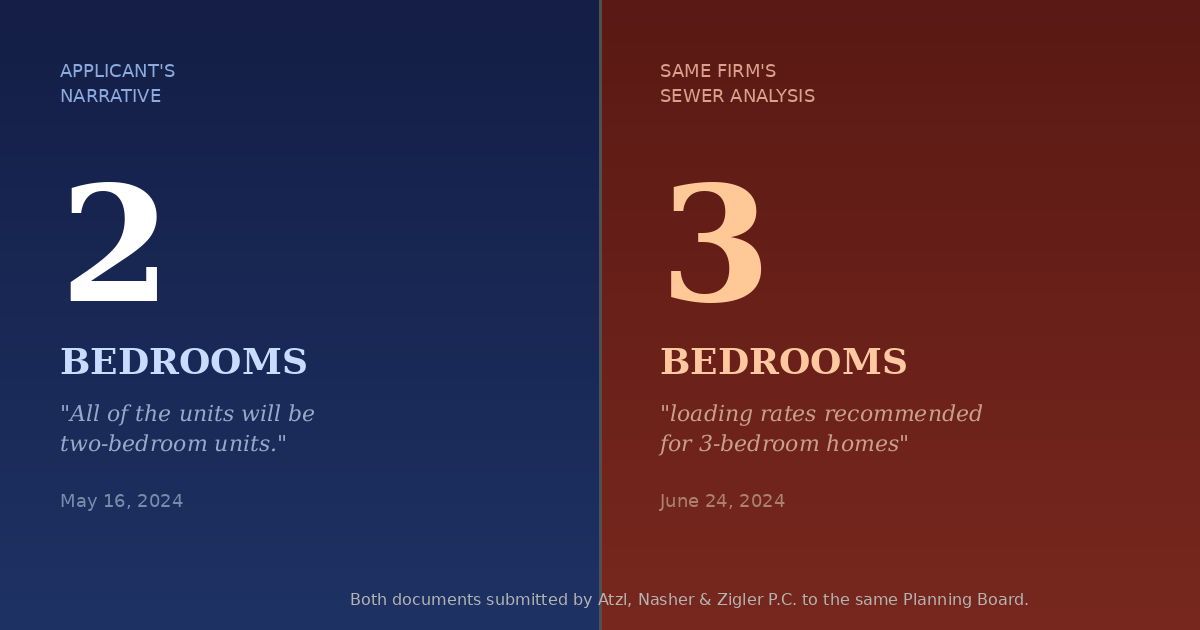
The Sewer Analysis Report, dated June 24, 2024, was stamped by Vahid Rostami, Ph.D., P.E., of the same engineering firm, Atzl, Nasher & Zigler P.C., that authored the narrative stating the units were two bedrooms.[12] The narrative and the sewer analysis were submitted to the same Planning Board as part of the same application. One document said two bedrooms. The other calculated for three. Both bore the professional imprimatur of the same firm.
The zoning code limits Active Adult units to two bedrooms. The applicant’s narrative states two bedrooms. The same firm’s sewer analysis calculates loading rates for three bedrooms. Four independent reviewers (the Village Planner in February 2024, the second Village Planner in August 2024, the Planning Board Chairman in September 2024, and the Village Engineer in September 2024) each flagged the bedroom count as a concern. Across eight months of review, the applicant’s response and the architectural floor plans remained unchanged.
Sewers: Adequate or Not
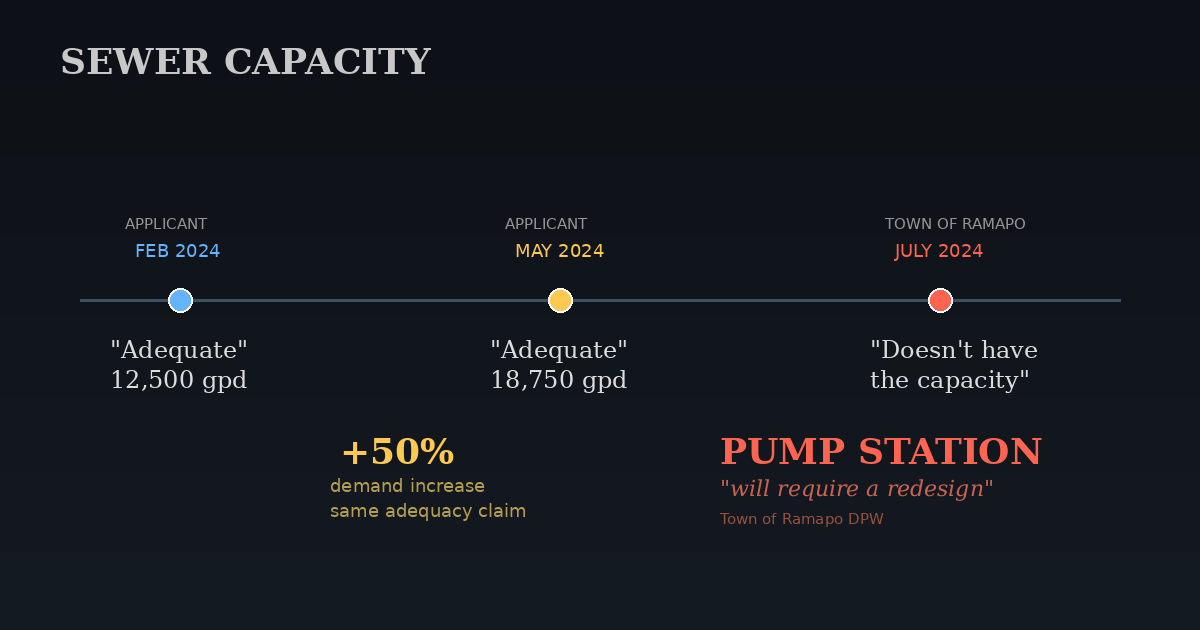
The applicant’s February 2024 narrative stated: “Both the sanitary sewer and water mains are adequate to serve the project,” with water and sanitary demand estimated at 12,500 gallons per day.[5] Village Planner Lange noted this figure “appears to be lower than established standards, not including the swimming pool or health club.”[10] In May 2024, the applicant revised the demand estimate upward to 18,750 gallons per day, a 50% increase, while maintaining the same assertion: “Both the sanitary sewer and water mains are adequate to serve the project.”[11]
On March 13, 2024, the Town of Ramapo Department of Public Works reviewed the plans and stated that “a sewer study is required.”[15] On July 29, 2024, after reviewing the sewer study the applicant subsequently submitted, the same department wrote: “The study provided is incorrect as the sewage enters a pump station on Gloria Drive. We typically require a peaking factor of 4.2. We need to see the calculations for the peaking factor utilized. Provide entire map of contributing area to sewage system. The current pump station doesn’t have the capacity to handle this project and will require a redesign.”[16]
The February 2024 narrative also stated the site would be served by “private water.” In May, the applicant acknowledged this was “incorrect” and that the project would be served by Veolia Water and a municipal sewer system.[11] The Rockland County Sewer District, in its own June 12, 2024 review, calculated a $90,650 impact fee for the project and warned that if the use exceeds 57 units, additional fees would be required.[11]
Key facts: The applicant’s February 2024 narrative contained three statements that were subsequently contradicted: the water source (”private water,” later admitted to be incorrect), the demand estimate (12,500 gpd, later revised upward by 50% to 18,750 gpd), and the sewer adequacy claim (”adequate,” contradicted by the Town of Ramapo DPW, which stated the pump station “doesn’t have the capacity” and “will require a redesign”). The 55-unit project on 9 acres shares sewer infrastructure with the proposed 325-home development on the adjacent 150 acres.
A Pattern in Court
The 103 Brick Church proposal is not the first time the Village’s land use decisions have been challenged in court, and it is not the first time a court has sided with the challengers.
In 2020, the Village adopted a new Comprehensive Plan that created zoning designations including a “Fairway Park Village Center Zone.” In 2021, the Village adopted Zoning Amendments derived from that plan. On January 10, 2024, Justice Sherri Eisenpress of the Rockland County Supreme Court voided the 2020 Comprehensive Plan, the 2021 Zoning Amendments, and the Village Zoning Map. The court found that the Board had created zoning designations that “did not exist, were undefined, and were not codified in the Village Code,” that the Village had failed to take a “hard look” at environmental concerns as required by SEQRA, and that it had failed to comply with General Municipal Law requirements for referral to the County Planning Board. The plaintiffs were the Hillcrest Fire Company #1, the Kearsing & Edwards American Legion Post 1600, and several residents.[17]
In a separate matter, the Village purchased 22 acres of designated parkland surrounding Fairview Oval from the Town of Ramapo for $1.35 million, land appraised at $3.4 million. The Village then sold more than five acres of that parkland to the Yeshiva of Greater Monsey at 667 New Hempstead Road for $1.2 million. The net cost to the Village was $150,000 for 16 acres. Mayor Abe Sicker stated publicly that the yeshiva could “potentially construct another building” on the five acres. Three residents (Stanley Iskowitz, Susan Iskowitz, and Zvi Raskin) filed an Article 78 petition to block the sale, arguing that the Town Board’s declaration of the land as surplus was arbitrary and capricious, that the sale lacked state approval to alienate parkland, and that the approval failed to meet SEQRA requirements. The land had been designated parkland in 1972 as a condition of the original Fairview Oval subdivision approval.[18]
In yet another matter, the Town of Ramapo had acquired 25 acres at 301 Pomona Road in the Village of New Hempstead using municipal bonds specifically to preserve the land as open space. In 2017, the Ramapo Local Development Corporation sold that 25-acre parkland to Parkway Gateway Development LLC, a Delaware limited liability company, without obtaining the State Legislature approval that New York law requires for the sale or transfer of designated parkland. The Skyview Acres Land Trust and neighboring residents filed suit in March 2022 (Index No. 033741/2022) seeking to set aside the transfer.[19]
On April 17, 2026, Justice Rachel Tanguay of the Rockland County Supreme Court issued a 32-page Decision and Order in that case declaring that the Fairway Park subdivision lands are “parklands pursuant to state law.” The court found that the Town’s own actions over five decades, including Town Board resolutions, cover letters, and official maps that used the word “park,” constituted an implied dedication as parkland. Under the public trust doctrine, the Town cannot alienate those lands without State Legislature approval.[20] The Town of Ramapo defended this case with public funds, arguing that land acquired with taxpayer-funded municipal bonds for the purpose of preserving open space was not, in fact, parkland.
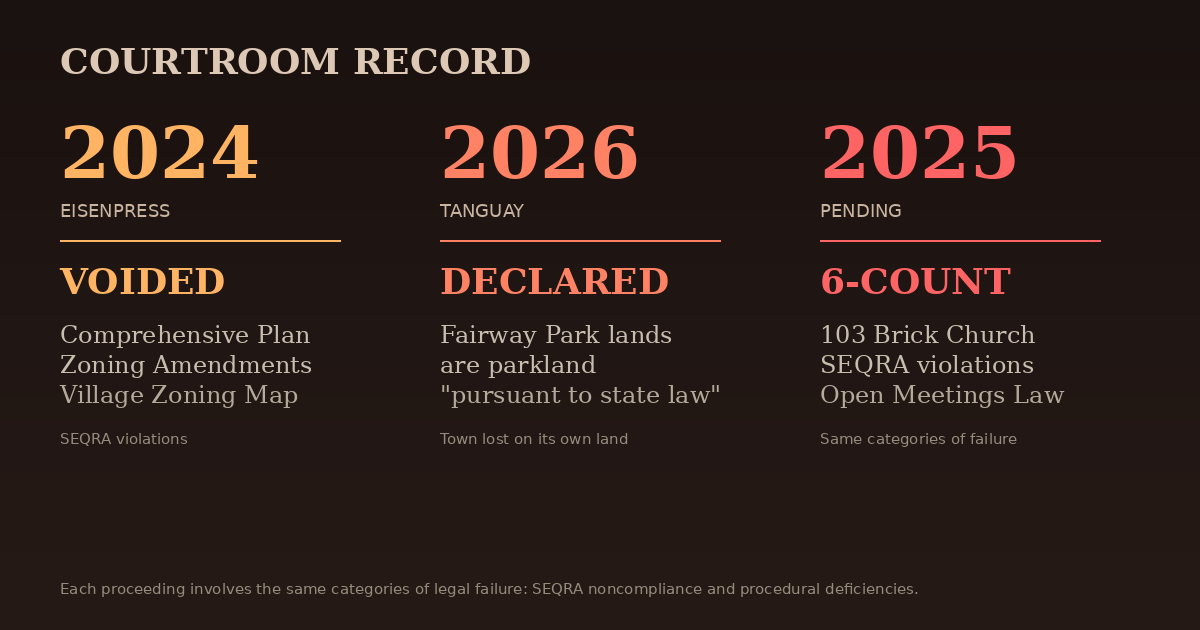
In December 2025, neighbors filed suit in Rockland County Supreme Court against the Village of New Hempstead over the 103 Brick Church development. The six-count complaint alleged Open Meetings Law violations, SEQRA violations, failure to keep proper minutes, failure to post minutes, non-noticed resolutions passed without public participation, and illegal segmentation of the environmental review.[21] The same categories of legal failure that resulted in the voiding of the 2020 Comprehensive Plan are now alleged in the 103 Brick Church proceeding.
In January 2024, a court voided the Village’s Comprehensive Plan for creating zoning categories that did not legally exist and for failing to comply with SEQRA. In April 2026, a court declared the Fairway Park subdivision lands to be parkland, after the Town spent public funds arguing they were not. In December 2025, neighbors filed a six-count lawsuit against the Village over the 103 Brick Church development, alleging the same categories of SEQRA and Open Meetings Law violations that resulted in the prior courtroom loss.
What the Residents Were Told
The golf course property is currently zoned 1R-40, requiring minimum lot sizes of 40,000 square feet. The proposed development requires a new zone, 1R-10, with minimum lot sizes of 10,000 square feet. That zone does not currently appear in the Village Code.[1] If the Board of Trustees creates it for this development, it will exist as an available zoning classification for every future rezoning application in the Village.
On the Union Road project, the Hillcrest Fire Company reviewed the plans and noted the “lack of fire hydrants on the parcel,” questioned whether two parking spaces per unit would be adequate, and warned that “illegally parked vehicles can seriously hinge FD operations / access.”[22] The Rockland County Highway Department stated that the development “has a potential to impact the existing traffic condition in the area” and that the applicant must “investigate the concern and provide adequate mitigation measures.”[23] More than twenty neighboring residents signed a petition requesting a turning lane, new sidewalks, and a reconfigured entrance and exit.[24] The applicant’s response to the sidewalk request: “It’s our understanding, that the Village is currently developing a sidewalk plan for Union Road.”[11] No such plan appears in the public record.
At the July 9, 2024 public hearing, Jonas Goldschmidt of told the Planning Board that the area is being overdeveloped and that “the current infrastructure needs to be upgraded for safety reasons before the approval of any further development takes place.” Mrs. Walter of raised concerns about “the safety of Union Road due to the lack of sidewalks and street lights.” Rebecca Levy of said the development would be “too dense” and raised concerns about sewage, traffic, and flooding.[13]
The proposed 1R-10 zone does not currently exist in the Village Code. The Hillcrest Fire Company identified a lack of hydrants and warned that the parking design could block fire apparatus access. The Rockland County Highway Department required traffic mitigation measures. More than twenty residents signed a petition requesting sidewalks, a turning lane, and a reconfigured entrance. The applicant deferred the sidewalk request to a Village plan that does not appear to exist.
Who Decides
At the February 24, 2026 meeting of the Village Board of Trustees, Mayor Abe Sicker addressed the question of code enforcement within the Village. His statement, recorded in the minutes, was that “the judge gave us the right to enforce or not to enforce.”[25] Code enforcement is the mechanism by which a municipality ensures that its zoning, building, and safety codes are followed. The mayor’s characterization describes it as a matter of discretion rather than obligation.
The Village held a general election in March 2026. Fifty residents voted in the prior election. Three hundred and seventy-seven voted in this one. The Board of Trustees’ own resolution adopting the election date omitted the offices to be filled, as required by Election Law §15-104, and was adopted six days past the statutory deadline. No evidence of compliant statutory notice to residents appeared in the Village’s published minutes.[26]
At the March 26, 2024 Board of Trustees meeting, every governance position in the Village was filled by mayoral appointment: the Village Attorney, the Village Prosecutor (the same individual), the Acting Associate Justice, the Planning Board Chairman and Deputy Chairman, the ZBA Chairman and Deputy Chairman, ad-hoc members of both boards, and the Deputy Mayor.[27] Every position is a one-year term. Every position is renewed or replaced at the mayor’s discretion annually.
The mayor appoints every governance position in the Village annually, including the Village Attorney (who also serves as Village Prosecutor), the Planning Board Chairman, the ZBA Chairman, and the Acting Associate Justice. The mayor described code enforcement as discretionary on the public record. The Village’s election resolution omitted the offices to be filled and was adopted six days past the statutory deadline.
The Record
The record shows a pattern. In 2007 and 2009, the Village entered into recorded agreements designed to preserve the golf course as open space, with development rights held by the Village in perpetuity. In 2020, the Village adopted a Comprehensive Plan that rezoned portions of the same land for development, and a court voided it for creating zoning categories that did not legally exist and for failing to comply with environmental review requirements.
In 2022, the Village purchased designated parkland at a steep discount and sold a portion of it to a yeshiva for institutional use. In 2023, the golf course was sold to a developer for $35 million. In 2024, the Village began advancing a rezoning that would allow 325 homes on 10,000-square-foot lots in a zone that does not exist in the Village Code, on land where the Village’s own attorney stated on the record was not supposed to be developed and where the Village may hold development rights in perpetuity.
In 2025, neighbors filed suit alleging the same categories of legal failure that had already resulted in the voiding of the Village’s prior land use plan. In April 2026, a Supreme Court justice declared the Fairway Park subdivision lands to be parkland by implication, after the Town spent taxpayer money arguing they were not. In February 2026, the mayor stated on the record that code enforcement is discretionary.
On the Union Road project alone, the applicant’s engineering firm told the Planning Board the units contained two bedrooms while the same firm’s sewer analysis calculated loading rates for three-bedroom homes. The applicant’s narrative stated that the sanitary sewer was adequate to serve the project; five months later, the Town of Ramapo’s Department of Public Works stated that the pump station does not have the capacity and will require a redesign. The first professional reviewer, the Village Planner, and the Planning Board Chairman all raised concerns about the bedroom count, and the applicant’s response and floor plans remained unchanged across eight months of review.
At the July 9, 2024 public hearing, Newton Paul told the Planning Board he “worries that this will set a precedent and there needs to be balance.”[13]
Each of these events is documented in court filings, recorded instruments, DEC notices, planning board submissions, professional review letters, village minutes, or published reporting.
On March 12, 2024, the Village Attorney stated on the record that the golf course was “the only part that was able to be developed.” The Village Board is now advancing a 325-home rezoning on that same golf course, in a zone that does not exist in the Village Code, on land where the Village may hold development rights in perpetuity. The applicant’s own engineering submissions contradict each other on the number of bedrooms and the capacity of the sewer system. A six-count lawsuit alleging the same categories of legal failure that voided the Village’s last land use plan is pending in Rockland County Supreme Court.
Endnotes
NYS DEC Environmental Notice Bulletin, Positive Declaration, Village of New Hempstead, 103 Brick Church Road, June 5, 2024. Proposed action: up to 325 single-family homes in a new 1R-10 zone with 10,000 sq ft minimum lots. Current zoning: 1R-40.
Amended Forbearance Agreement, January 8, 2007, between New York Golf Enterprises Inc. and Village of New Hempstead. Recorded September 6, 2007, Rockland County Clerk, Instrument 2007-00044358. Signed by Lawrence Dessau, Mayor, and Cheon Cho, President.
Forbearance Agreement, July 21, 2009, between New York Golf Enterprises Inc. and Village of New Hempstead. Rockland County Clerk, County File 2010-00009588. Signed by Lawrence Dessau, Mayor, and Cheon Cho, Vice President.
Final Subdivision Plat, Map 8068, New York Country Club, Village of New Hempstead. Filed October 16, 2009, Rockland County Clerk. Prepared by Atzl, Scatassa & Zigler P.C., Project No. 3193. Two lots: Lot 1 (149.6923 acres), Lot 2 (9.2885 acres). Zone: 1R-40.
Union Road Townhomes, Narrative Summary, February 8, 2024, prepared by Atzl, Nasher & Zigler P.C. Submitted as part of special permit application under Village of New Hempstead Zoning Code §290-57.
Village of New Hempstead Planning Board Minutes, March 12, 2024. Statement of Village Attorney Bruce Minsky regarding Forbearance Agreement density and development limitations.
Village Planner Jonathan T. Lockman, AICP (NPV), review memorandum to Planning Board, June 13, 2024. Re: Union Road Townhomes, SBL# 50.05-1-11.2. Comment 1a regarding Forbearance Agreement superseding code density.
Levi Marmulszteyn, 647 Union Road, letter to Village of New Hempstead Planning Board, August 4, 2024. Independent legal analysis of Forbearance Agreements.
Village of New Hempstead Zoning Code §290-57 J(1); Table of Dimensional Requirements, 290 Attachment 2 (dated 11-01-2018).
Village Planner John Lange (Lange Planning and Consulting), review letter to Mayor and Board of Trustees, Village of New Hempstead, February 29, 2024. Re: Application for a Special Permit Active Adult Development on Union Road. Note: Lange also identified that SEQRA forms listed in the applicant’s submission package were not actually included.
Union Road Townhomes, Narrative Summary with Responses to Comments, May 16, 2024, prepared by Atzl, Nasher & Zigler P.C. (Project No. 3193 Narr, c&r 5-16-24). The February 2024 narrative stated water/sanitary demand at 12,500 gpd; the May 2024 narrative revised this to 18,750 gpd while maintaining the same sewer adequacy claim. The February narrative also incorrectly stated the site would be served by “private water”; the May revision acknowledged this was “incorrect” and that the project would be served by Veolia Water.
Village Planner Jonathan T. Lockman, AICP (NPV), review memorandum to Planning Board, August 14, 2024. Re: Union Road Townhomes. Floor plans by AB Design (Boaz Golani, RA), stamped September 7, 2023. Sewer Analysis Report by Vahid Rostami, Ph.D., P.E., Atzl, Nasher & Zigler P.C., dated June 24, 2024.
Village of New Hempstead Planning Board Minutes, July 9 and September 3, 2024. Public hearing testimony from residents including Goldschmidt, Walter, Levy, Paul, Sherman, and others. Chairman Poliakoff bedroom concerns; board discussion regarding offices configured with closets.
Village Engineer Glenn McCreedy, P.E. (Civil Design Works LLC), review letter, September 3, 2024. Re: Union Road Townhomes, CDW#NH20-606.
Town of Ramapo Department of Public Works, Paul Gdanski, P.E., review letter, March 13, 2024. Re: Union Road Townhomes, Tax Map Section 50.05-1-11.2.
Town of Ramapo Department of Public Works, Paul Gdanski, P.E., review letter, July 29, 2024. Re: Union Road Townhomes.
RCBJ, “Scathing Opinion From A Judge Rips New Hempstead’s Comprehensive Plan, Zoning Map,” January 21, 2024.
Yahoo News / Journal News, “Ramapo land sale to New Hempstead yeshiva draws suit from residents,” August 2022. Parkland designated in 1972 as condition of Fairview Oval subdivision approval.
RCBJ, “Skyview Acres Land Trust Sues Ramapo Over Parkland Sale,” April 3, 2022. Index No. 033741/2022, Rockland County Supreme Court.
Decision and Order, Hon. Rachel E. Tanguay, J.S.C., April 17, 2026. Index No. 033741/2022, NYSCEF Doc. No. 249. Filed Rockland County Clerk 04/17/2026. 32 pages. “ORDERED that this Court issues a declaratory judgement that lands owned by the Defendants within the Fairway Park Subdivision are parklands pursuant to state law.”
RCBJ, “Neighbors Sue Village of New Hempstead Over Golf Course Development,” December 14, 2025. Six-count complaint alleging Open Meetings Law and SEQRA violations.
Hillcrest Fire Company No. 1, review letter, June 28, 2024. Re: 618 Union Rd / 103 Brick Church Rd, SBL 50.5-1-11.2. Received by Village of New Hempstead June 28, 2024.
Rockland County Highway Department, Dyan Rajasingham, Engineer III, review letter, June 12, 2024. Re: Site Plan Review for Union Road Townhouses.
Petition to the Planning Board of Village of New Hempstead, NY, July 8, 2024. Signed by 20+ neighboring residents including Joseph and Rayla Salomon, and others. Referenced into the September 3, 2024 Planning Board record.
Village of New Hempstead Board of Trustees Minutes, February 24, 2026.
See “Did New Hempstead Residents Know There Was an Election?”, previously published.
Village of New Hempstead Board of Trustees Minutes, March 26, 2024. Annual organizational meeting. All governance positions filled by mayoral appointment.